
Your shopping cart is empty! Please select the type which you want.
Home > Mall Dynamic > A Brief Introduction To The Transistor And Its Working Principle
The main transistor here is an electronic component, and to put it in a simple analogy, our brain is made up of 100 billion cells called neurons, which are used to think and remember things. Computers, too, have billions of tiny brain cells called transistors. Transistors have been designed and successfully developed by JohnBardeen, WalterBrattain and WilliamShockley for more than half a century, and transistor technology is still constantly being broken and updated. The birth and development of transistors fundamentally influenced power electronics.
The transistor is a solid semiconductor device (including diode, transistor, field effect tube, thyristor, etc., sometimes especially bipolar devices), with detection, rectification, amplification, switching, voltage regulation, signal modulation and other functions.
As a kind of variable current switch, the transistor can control the output current based on the input voltage. Unlike ordinary mechanical switches (such as Relay, switch), transistors use electrical signals to control their own opening and closing, so the switching speed can be very fast,
and the switching speed in the laboratory can reach more than 100GHz.
In 2016, a team at Lawrence Berkeley National Laboratory broke the physical limits and reduced the most sophisticated crystal process available from 14nm to 1nm, achieving a major breakthrough in computing technology.
These devices are made of semiconductor materials commonly used for amplification or switching purposes, and can also be used to control the flow of voltage and current. It is also used to amplify the input signal into the extended area output signal.
Transistors are typically solid-state electronic devices made of semiconductor materials. The cycle of the current can be changed by adding electrons. This process makes the voltage change proportionally affect many changes in the output current, thereby doubling the amplification.
Except for most electronic devices, not all electronic devices contain one or more types of transistors. Some transistors are placed separately or are usually placed in integrated circuits, and these transistors will vary depending on the state application.
"A transistor is a three-legged insect component that is placed separately in some devices but in a computer, it is packaged into millions of small chips."

A transistor consists of three layers of semiconductors, which have the ability to maintain a current. Conductive materials such as silicon and germanium have the ability to transfer current between conductors and insulators surrounded by plastic wires. Semiconductor materials are processed by a certain chemical process called semiconductor doping. If the silicon is mixed with arsenic, phosphorus and antimony, it will gain some extra charge carriers, namely electrons, called N-type or negative semiconductors; And if the silicon is mixed with other impurities (such as boron), gallium, and aluminum, it will acquire fewer charge carriers, known as P-type or positive semiconductors.
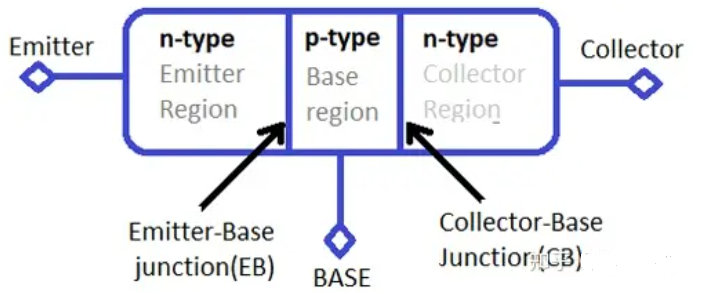
How it works is a major part of understanding how to use a transistor or transistor. How does it work? There are three terminals in a transistor:
• Base: It provides the base for the transistor electrode.
• Emitter: The resulting charge carrier.
• Collector: The resulting charge carrier.
If the transistor is of type NPN, we need to apply a voltage of 0.7v to trigger it, and apply this voltage to the transistor tu of the base tube for forward bias condition conduction, and current begins to flow through the collector to the emitter (also known as the saturated region).
When the transistor is in the reverse-biased state or the base pin is grounded or without voltage, the transistor remains in the cutoff state and does not allow current to flow from the collector to the emitter (also known as the cutoff region).

If the transistor is PNP type, it is usually ON, but not perfect, until the base is fully grounded. After grounding the base pin, the transistor will be in a reverse-biased state or what is known as the on-state.
As a power supply to the base pin, it stops the conduction of current from the collector to the emitter, and the transistor is in a cutoff or forward-biased state.

To protect the transistor, we have a resistor in series and find the value of the resistor using the following formula:
RB=VBE/IB
In a strict sense, transistors generally refer to all single components based on semiconductor materials, including diodes (two-terminal), triodes, field-effect tubes, and thyristors (the last three are three-terminal) made of various semiconductor materials. Transistors sometimes multidigit transistor.
Three-terminal transistors fall into two main categories: bipolar transistors (BJT) and field-effect transistors (FETs). A transistor has three poles (terminals); The three poles (terminals) of a bipolar transistor are respectively the Emitter, Base and Collector composed of N-type and P-type semiconductors.
The three poles (terminals) of a field-effect transistor are the Source, the Gate and the Drain.
Because the transistor has three electrodes, it also has three ways of using, respectively, emitter grounding (also known as common emitter amplification, CE configuration), base grounding (also known as common base amplification,
CB configuration) and collector grounding (also known as common set amplification, CC configuration, emitter with coupler).
Mall Dynamic
