
Your shopping cart is empty! Please select the type which you want.
Home > Mall Dynamic > Basic Knowledge And Application OF Variable Capacitors
Variable Capacitor, referred to as "variable capacitor, adjustable capacitor" (English: Variable/adjustable Capacitor), is a capacitor whose capacitance can be continuously adjusted within a certain range. The principle is generally that by changing the relative effective area or distance between the poles, its capacitance changes accordingly. Variable capacitors, generally used as tuning, compensation capacitors/correction capacitors in various tuning and oscillation circuits of devices such as radios (such as radios, televisions) or NFC/RFID card readers. The following are some common variable capacitors:

The electrical principle symbol of variable capacitors is shown in the figure: a diagonal arrow passes through the conventional capacitor symbol to indicate that its capacity is variable, and a T-shaped nail head (or arrow) indicates that the capacitance value can be changed less, and it is a fine-tuning capacitor.

No matter what kind of variable capacitor, its electrodes are composed of two sets of mutually insulated metal sheets. Below, we use the earliest air-medium variable capacitor (a capacitor in a variable capacitor) to explain its structure and working principle: as shown in Figure 2, a fixed group of two groups of electrodes is a fixed plate, a group that can rotate is a moving plate, and air is used as a medium between the moving plate and the fixed plate. When the moving plate of the air dielectric variable capacitor is rotated to make it all screw into the fixed plate, its capacitance is the maximum; On the contrary, when all the moving pieces are rotated out of the fixed space, the electrical capacity is minimum
In practical applications, the moving plates of several variable capacitors can be assembled on the same rotating shaft to form coaxial variable capacitors (commonly known as double, triple, or even N, etc.). Variable capacitors have a long handle, which can be adjusted with a cable or dial. Therefore, air medium variable capacitors are divided into air single variable capacitors (referred to as air single) and air double variable capacitors (referred to as air double, which is composed of two groups of moving pieces and fixed pieces, and can be coaxial synchronous rotation)
Variable capacitors can be divied into air medium variable capacitors and solid medium variable capacitors according to the medium materials they use.
Air dielectric variable capacitor is a capacitor with air as the medium, which is composed of a number of movable plates that can be rotated 180° and a number of fixed fixed plates, and its capacitance is continuously adjustable within a certain range. When all the moving pieces are rotated into each other, the electric capacity is the maximum. On the contrary, when the moving piece is completely rotated out of the fixed piece, the capacitance is minimum. The following figure (Figure 3) shows the typical appearance of an air dielectric variable capacitor:

Air dielectric variable capacitors have the characteristics of precise adjustment of capacitance, low dielectric loss (i.e., high Q value), good stability, long life, large volume and high insulation resistance. This kind of air dielectric variable capacitor is generally used in radios, electronic instruments, high-frequency signal generators, communication equipment and related electronic equipment.
Solid medium variable capacitors are divided into sealed single variable capacitors (referred to as sealed single), sealed double variable capacitors (referred to as sealed double capacitors, which has two sets of moving plates, fixed plates and media, which can be coaxial synchronous rotation) and sealed quadruple variable capacitors (referred to as sealed quadruples, which has four and moving, fixed plates and media). Its advantages are small size and light weight; The disadvantage is loud noise and easy to wear.

Structurally, the solid medium variable capacitor is a mica sheet or plastic (polystyrene and other materials) film as a medium between the moving plate and the fixed plate (both of which are irregular semicircular metal sheets), and the shell is transparent plastic. Its common appearance is shown in the following figure (Figure 4) :
As shown in (Figure 5), sealed single variable capacitors are mainly used in simple radios or electronic instruments; Sealed double variable capacitors are used in transistor radios and related electronic instruments and electronic equipment; Sealed four variable capacitors are commonly used in AM/FM multiband radios. So, now you understand that when you adjust the station, you are actually changing the capacitance value, and finally achieving a change in the radio resonance frequency.

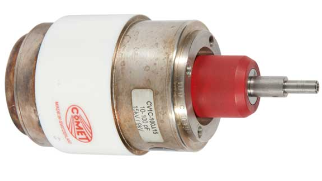
A vacuum capacitor (as shown in Figure 6) is a capacitor that uses vacuum as a medium. The electrode bank of this capacitor is a set of concentric cylindrical electrodes formed by using high-conductivity oxygen-free copper strips drawn through a set of high-precision molds and sealed in a vacuum container. Therefore, its performance is stable and reliable, and it is not easy to produce arc, corona and other phenomena. Compared with capacitors of other media, vacuum capacitors have the characteristics of high voltage (up to hundreds of thousands of volts), small size, low loss, high rated current, stable and reliable performance. It is generally used in military broadcasting communication equipment, high-energy particle accelerator, semiconductor manufacturing equipment, medical analyzer and therapeutic instrument.
Trimmer Capacitor (English name: Timmer Capacitor) is also a variable capacitor with a small capacity variation range, usually only a few to dozens of picometres, and is fixed to a certain capacitance value after adjustment
Trimmer capacitors are semi-fixed adjustable capacitors whose electrostatic capacity can be freely changed. Generally speaking, there is basically no need to change after the first setting. Compared with general capacitors, trimmer capacitors increase the function of electrostatic capacity adjustment, the principle (method) mainly has the following three kinds, usually most of them are used method 1.
Method 1: Change the electrode overlap area.
Method 2: Change the distance between electrode overlaps.
Method 3: Change the relative dielectric constant of the dielectric.
According to the material structure, the fine-tuning capacitor can be divided into porcelain fine-tuning capacitor, film fine-tuning capacitor, mica fine-tuning capacitor, piston fine-tuning capacitor, and so on. Here we briefly introduce:
The capacitor is made of ceramic as the medium, which is a common fine tuning capacitor at present. A semicircular silver layer is plated on the moving piece (porcelain piece) and the fixed piece (porcelain piece), and the capacitance can be changed by rotating the moving piece to change the distance between the two silver pieces. Such capacitors are shown in Figure 7

Thin film trimmer capacitor is an organic plastic film as a medium, that is, an organic plastic film is added between the moving sheet and the fixed sheet (both of which are irregular semicircular metal sheets), and the screw on the moving sheet is adjusted to make the moving sheet rotate, so that the capacitance can be changed.
Thin film trimmer capacitors are generally divided into double trimmer and four trimmer. Some sealed double or sealed four variable capacitors come with thin film trimmer capacitor, the double or four and trimmer capacitor are made into one, the trimmer capacitor is installed on the top of the shell, and it is convenient to use and adjust. This type of capacitor is shown in Figure 8:

The capacitance of the capacitor is changed by adjusting the distance between the plate and the fixed plate with a screw. The moving plate is an elastic copper sheet or aluminum sheet, and the fixed plate is a fixed metal sheet, which is coated with a layer of mica sheet as a medium. Mica trimmer capacitors are divided into single trimmer and double trimmer, and the capacitance can be adjusted repeatedly. Such capacitors are shown in Figure 9:

This type of capacitor uses a fine-tuned metal rod as the inner electrode, a sintered silver layer as the outer electrode, and a glass tube or ceramic tube as the medium. Its fine tuning precision is very high, and it is often used in precision electronic instruments. Such capacitors are shown in Figure 10:

Wire trimmer capacitor was early used in the radio oscillation circuit as a compensation capacitor, which is based on the silver coated porcelain tube matrix as a fixed piece, and the thin metal wire wrapped outside (generally fine copper wire) as a moving piece, reducing the number of turns of the wire, you can change the capacitance. Its disadvantage is that once the wire is pulled off, it can not restore the original [capacitance, its capacitance can only be adjusted from large to small. [Note: there is no physical picture for reference]
In addition, there are also CNC variable capacitors with semiconductor properties on the market (not varactance diodes), such as the LXRW series products produced by Murata, Japan, which can change the electrostatic capacity value by applying the voltage on the terminal to achieve 50% capacitance change. As shown in Figure 11, a low voltage of about 3V can control a 50% change in capacitance!

Mall Dynamic
